Home Blog Mobile App Development In-App Purchases vs Subscriptions: Picking the Right Model for Your App Idea
In-App Purchases vs Subscriptions: Picking the Right Model for Your App Idea
- 27 Oct / 2026
- 31 views
- 9 Min Read
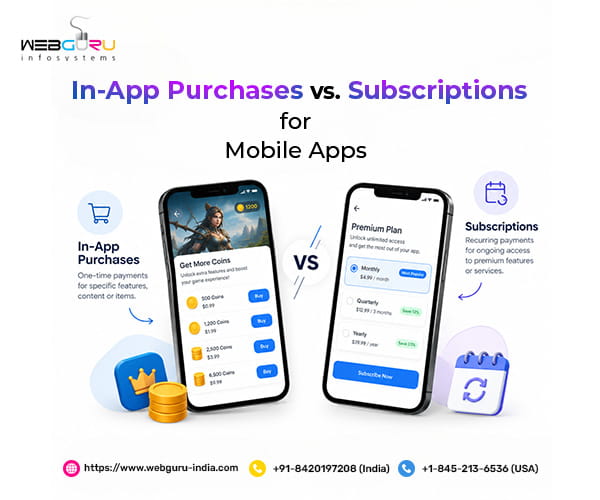
Navigating app monetization is a make-or-break decision for modern app creators. Selecting between one-time in-app purchases (IAP) and recurring subscriptions directly dictates user acquisition costs, churn rates, and long-term customer lifetime value. This blog post breaks down the fundamental mechanics, revenue predictability, and user retention profiles of both models. By analyzing category fit, pricing structures, and hybrid monetization frameworks, app owners can make an informed choice that aligns with their business goals, technical requirements, and target audience expectations.
Here’s a conversation we have more often than you’d think. A founder shows up with a solid app concept, a clear audience, and a launch date. We ask how it will make money. The answer: “Ads, maybe? Or a subscription? We’ll figure it out later.”
Later is where it gets expensive. If you talk to a mobile app development company before the screens are locked, the payment flow gets designed alongside everything else. If you wait, someone has to cut a paywall into a finished app, and that usually means reworking onboarding, navigation, and the backend too.
And it’s not a niche concern. According to industry revenue data reported by Statista, over 98% of global mobile app store revenue is generated through freemium monetization strategies. These are driven mostly by in-app purchases and recurring subscriptions rather than upfront paid downloads.
Hardly anyone is getting rich charging $2.99 at the download button. So you’re really choosing between two flavors of freemium. Which one suits you?
Explore how to validate a mobile app idea before you build it.
Understanding In-App Purchases (IAP)
An in-app purchase means the app is free to download and people pay for specific things once they’re inside. Coins in a mobile game are the classic example (consumables: you spend them, then buy more). A one-time “remove ads” unlock is a non-consumable, since you buy it once and keep it. Virtual items like a new avatar outfit or a themed filter pack fall in the same bucket.
Why founders like it:
- Almost no friction at the start. People download, poke around, and spend only if something grabs them.
- It catches impulse buying. Someone stuck on level 40 will happily pay 99 cents.
- Your biggest fans can spend a lot. In many games, a small group of heavy spenders (the “whales”) covers a big share of revenue.
The trade-off is cash flow, which can be bumpy. You run a seasonal event, and revenue jumps. The following month it’s flat, and nobody on your team can say why. Also, because people are buying things rather than committing to anything, you need a steady stream of new downloads to keep transactions coming. Pause your marketing and the graph tends to show it within a few weeks.
IAP suits mobile games, photo and video editors that sell filters, marketplaces where users pay per order, and event ticketing apps. Basically anywhere the value lands in one moment.
Understanding the Subscription Model
Picture a language-learning app. People open it every morning, protect their streak, and new lessons keep appearing. Asking for $9.99 a month feels reasonable there, because it’s something they use, not something they bought once.
That’s a subscription: weekly, monthly, quarterly, or annual billing in exchange for ongoing access.
Getting someone to agree to a recurring charge before they’ve felt any benefit is a big ask. So you’ll spend real effort on free trials, onboarding, and getting to the “oh, this is useful” moment fast. Then there’s subscription fatigue. People scroll through their bank statements and cancel whatever they haven’t opened lately, and if you stop adding value, churn quietly eats your numbers.
When it works, though, it’s a nicer business to run:
- Monthly Recurring Revenue (MRR) is steady enough to plan hiring and server costs around.
- Lifetime value (LTV) climbs the longer people stay. One subscriber paying for 18 months beats a pile of one-time buyers who drifted off.
- You’re nudged to keep improving the product, which is a good habit to be forced into.
It fits SaaS tools, fitness tracking, streaming, educational platforms, and news or content portals.
In-App Purchases vs Subscriptions: Core Comparison
Here’s the side-by-side.
| Metric | In-App Purchases (IAP) | Subscriptions |
|---|---|---|
| Revenue Predictability | Variable & transaction-dependent | High (recurring MRR) |
| User Acquisition Friction | Very Low | Low-to-Moderate (requires value proof) |
| Customer Retention Focus | Re-engagement & continuous incentives | Feature value, updates & churn reduction |
| Monetization Mechanics | Pay-per-item or pay-per-feature | Pay-for-ongoing-access |
| Average LTV Potential | Highly variable per user tier | Consistently high across active cohorts |
Most founders end up caring about the first row more than the rest, because it decides how comfortably you can plan the next six months.
Key Factors to Consider When Selecting Your Model
How do you actually decide?
Start with your category. Users walk in with expectations. Nobody blinks at paying monthly for a meditation library. But charge monthly for a one-time PDF scanner, and the reviews will tell you exactly how that went.
Also look at who’s paying. Be honest about these:
- How much disposable income does your audience really have?
- Are they used to paying for apps, or do they expect everything free?
- Does one price work everywhere, or do you need regional pricing?
This last one trips people up. ₹149 a month and $9.99 a month are not the same decision for a user, even if the app is identical.
Then there’s the technical side. This is something people often underestimate. Neither model is just a “buy” button. You need server-side receipt verification so nobody can fake a purchase, integration with Apple’s StoreKit and Google Play Billing, logic for renewals, refunds, and grace periods, and a Restore Purchases button (Apple expects one). Both stores also take a cut. The figure lies somewhere between 15 and 30 percent, depending on your program and how long a subscriber has stayed. So check current terms before you set prices. This is where mobile app development services earn their keep, because a billing bug rarely throws an error. It just shows up as revenue that never arrived.
Lastly, you don’t have to pick just one. Duolingo sells a subscription and in-app currency. Plenty of editing apps offer a monthly plan plus one-off premium packs. The base plan brings steady income, and the add-ons catch people who’d never subscribe but will gladly pay for a single thing.
Making the Strategic Choice for Your App Strategy
Try this gut check, and answer it honestly rather than optimistically:
- Will people use your app weekly, or only now and then?
- Does the value build up over time (progress, content, history)?
- Can your team realistically ship something worth talking about every month?
- Can you live with uneven months, or do you need steady cash coming in?
If you’re nodding along to the first three, a subscription is probably your lane. If your app is more of a “use it when you need it” tool, lean on IAP. And if your answers split down the middle, sketch out the hybrid before you rule it out.
Whichever way you go, the build matters as much as the model. Payment gateway integration, App Store and Google Play compliance, and cutting the number of taps between “I want this” and “bought” all have to be done properly.
Working with a proven mobile app development company is what turns a rough product concept into something that’s ready for the market and can scale without rebuilding the billing layer in year two.
Discover the top app retention strategies to ensure the success of your app.
Next Steps for App Monetization Success
Your first price won’t be your last. Launch, watch what people actually do, then test things: a 7-day trial against a 14-day one, the paywall one screen later, an annual plan priced at roughly ten months instead of twelve. Read your cancellation feedback and support tickets too. Users will tell you plainly when something feels too expensive or too thin.
If you’re sketching an app and can’t decide which way to go, talk to us at Webguru Infosystems. We’ll look at your idea and your audience, walk you through our custom mobile app development services, and show you cross-platform apps from our portfolio that we’ve already shipped.

Srishti Bhattacharyya
A writer driven by a love for words, who is constantly exploring new ways to push the boundaries of expression. Always testing the limits of creativity, she finds inspiration in books, painting, and the endless ideas waiting on Pinterest.
-
1000+
Happy
Clients -
25+
Countries
Served -
20+
Years of
Trust
I need help with...