Home Blog Mobile App Development Why Most App Launches Fail (And the 5 Fixes)
Why Most App Launches Fail (And the 5 Fixes)
- 14 Sep / 2026
- 171 views
- 8 Min Read
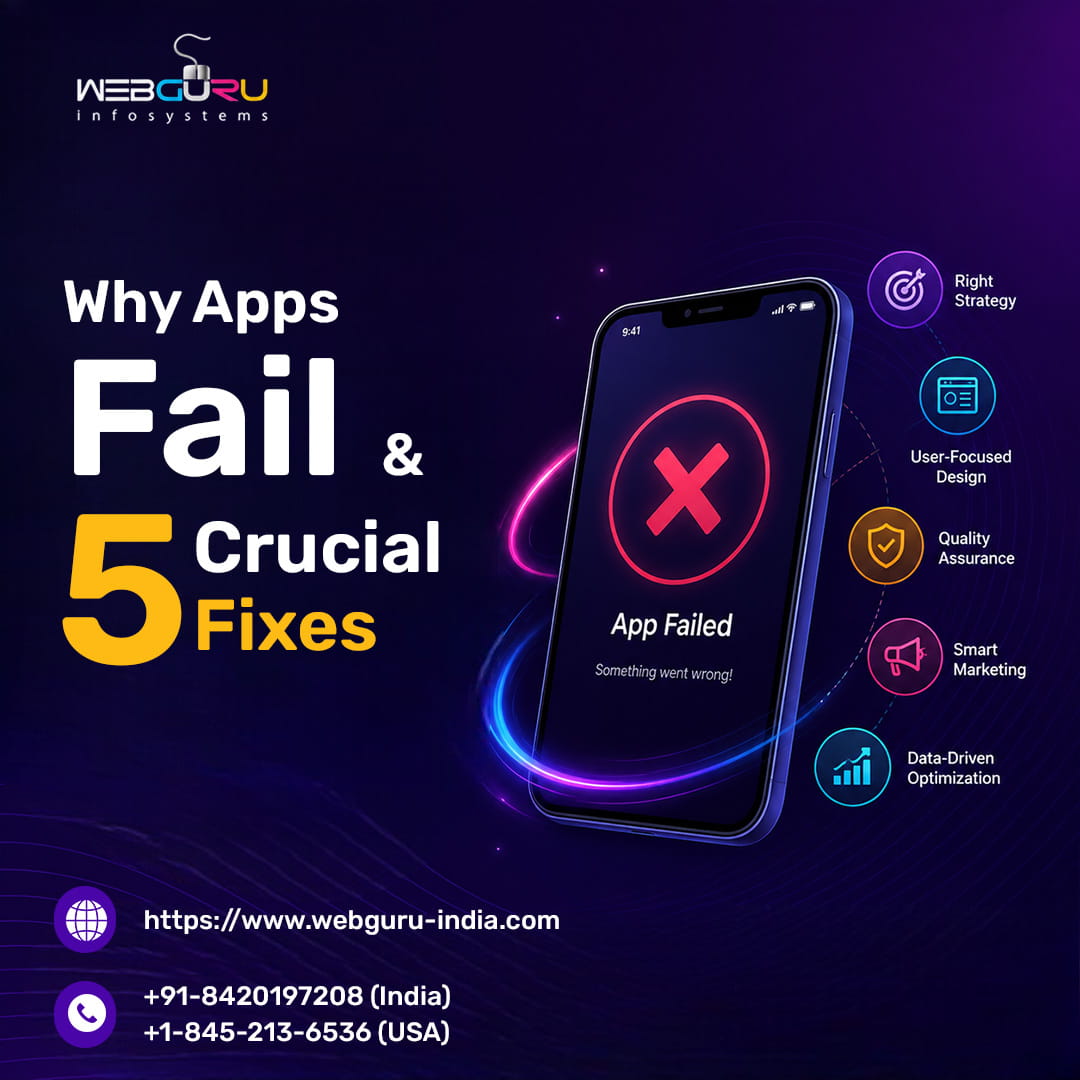
77% of users abandon a mobile app within three days of installing it. That’s not a fluke — it’s the predictable result of five strategic gaps most teams don’t catch until it’s too late: no market validation, bloated feature sets, rushed QA, zero post-launch marketing, and ignored analytics. Each one is fixable, and none of them require a bigger budget — just a smarter approach from day one. This guide walks through exactly what goes wrong at each stage and how to fix it, drawing on lessons from a mobile app development company that’s shipped apps built to actually retain users.
Open the App Store or Google Play right now and you’re staring down millions of competitors. Standing out isn’t hard — it’s brutal. The first time” is usually the only shot you get. And that’s exactly why so many businesses lean on a mobile app development company to get it right the first time,
Building an app was never really the hard part. Writing code, shipping features, hitting your launch date — that’s the easy 20%. The other 80% is strategy, and that’s where most launches quietly fall apart.
The numbers back this up. According to industry research cited by Business of Apps, the average mobile app loses nearly 77% of its Daily Active Users within just three days of installation. Three days. Not three months.
So what separates the apps that stick around from the ones that vanish into app store obscurity? Usually, it comes down to five fixable mistakes — strategy gaps that show up long before a user ever taps “install.” Let’s break them down, one by one.
Fix 1: Stop Guessing — Validate Market Demand Before Writing Code
The Problem
Too many founders build first and ask questions later. They fall in love with an internal idea, skip the validation step, and greenlight development based on assumptions instead of evidence. By the time real users see the product, it’s already solving a problem nobody actually has.
The Solution
Invest in deep market discovery first. This comes before you begin coding. Talk to your target users, benchmark competitor apps, and map the gaps they haven’t closed. Look at what’s already working in your category. More importantly, look at where those apps are still failing users. This gap is your opening.
This is where a seasoned team offering full-scope mobile app development services earns its keep. They’ve seen which assumptions hold up in the real world and which ones quietly sink promising projects before launch.
Pros:
- Saves thousands of dollars in wasted development
- Ensures genuine product-market fit before you scale
Cons:
- Adds time to your pre-launch planning phase
Start lean. Build a Minimum Viable Product that solves exactly one acute, well-validated problem — nothing more. You can always expand once real users confirm you’re onto something.
Discover how to validate a mobile app idea before you build it.
Fix 2: Simplify the Experience — Feature Creep Kills User Engagement
The Problem
It’s tempting to cram every “nice-to-have” idea into version one. The result? A bloated app with sluggish performance, a confusing interface, and users who bail within minutes because they can’t figure out what to do first.
The Solution
Strip your V1 down to its core functional value. Prioritize a frictionless, mobile-first UI/UX over feature quantity. Users don’t reward apps for doing the most. They reward apps for doing the right thing effortlessly. Every extra tap, screen, or setting is another chance for someone to give up and delete.
Pros:
- Faster load times
- Intuitive onboarding
- Noticeably higher retention rates
Cons:
- Forces hard calls on postponing features your team is excited about
Apply proven mobile-first design patterns and cap your onboarding sequence at three steps or fewer. If a new user can’t reach the “aha” moment within a minute of opening the app, something needs to go.
Fix 3: Eliminate Technical Debt with Rigorous Multi-Device QA
The Problem
Deadlines get tight, and QA is often the first thing squeezed. The app ships with unresolved edge-case bugs, crashes on certain devices, and struggles on inconsistent networks. The market punishes this instantly with one-star reviews, and it is often hard to come back from that.
The Solution
Treat QA as non-negotiable, not optional polish. That means testing across real devices, varied operating systems, and real-world network conditions — not just a single simulator on a fast office Wi-Fi connection.
A flagship phone on 5G tells you almost nothing about how your app behaves on a mid-range device with spotty coverage, which is exactly where a huge share of your actual users will be.
Pros:
- Protects your brand reputation from day one
- Reduces expensive post-launch emergency fixes
Cons:
- Requires dedicated testing environments and QA bandwidth
Leverage cross-platform frameworks like React Native alongside dedicated native testing pipelines. This helps you catch the edge cases that generic testing misses. Bugs found before launch cost a fraction of what they cost after. It is the reason why an experienced mobile app development company builds QA into every sprint instead of bolting it on at the end.
Fix 4: Treat Launch as the Start Line, Not the Finish Line
The Problem
Teams pour everything into development and treat launch day as the finish line. No marketing plan follows. The result? The app sits buried on page seven of search results, invisible to the very users it was built for.
The Solution
Build an integrated digital marketing funnel that starts before launch and continues well after it. Visibility doesn’t happen by accident. It’s engineered through search, social, and the app stores themselves.
Pros:
- Builds organic traffic momentum early
- Optimizes your customer acquisition cost (CAC) over time
Cons:
- Requires a dedicated marketing budget alongside development spend
Actionable Advice
Pair App Store Optimization (ASO) with targeted PPC, social campaigns, and smart push notification workflows that bring lapsed users back in. Launch day should be the beginning of your growth curve, not the end of your project.
Fix 5: Track the Right Metrics and Commit to Continuous Iteration
The Problem
Too many teams check download counts, feel good, and stop looking. Meanwhile, real usage data and user feedback loops go completely ignored. As a result, the app slowly bleeds users without anyone noticing until it’s too late. By the time someone finally checks the dashboard, the retention curve has already flatlined.
The Solution
Monitor real-world engagement continuously and treat feature updates as an ongoing commitment, not a one-time event.
Pros:
- Drives long-term Customer Lifetime Value (LTV)
- Meaningfully reduces churn over time
Cons:
- Demands ongoing operational commitment and maintenance resources
Track the metrics that actually matter instead of chasing vanity download numbers that say nothing about whether people are sticking around. Some examples of these are DAU/MAU ratio, session length, churn rate. This is also where ongoing mobile app development services pay for themselves.
Someone needs to own the roadmap after launch, not just the build.
Discover the top secretive features that make a mobile app addictive for users.
Turn Your App Vision into a Market Success
None of this is complicated in theory. Apps succeed when they’re built on validated demand, kept intentionally simple, tested rigorously, marketed deliberately, and improved continuously. It’s discipline, not luck. It’s the same playbook whether you’re launching your first app or your fifth.
This is precisely the kind of end-to-end thinking a trusted mobile app development company brings to the table. You get strategy, design, QA, and growth, working as one system instead of five disconnected steps.
If you’re ready to build an app that survives past week one, let’s talk. At Webguru Infosystems, we deliver mobile app development services, UI/UX design, and digital marketing built for businesses that want to scale globally — not just launch and hope. Gt in touch with us today to start planning.

Srishti Bhattacharyya
A writer driven by a love for words, who is constantly exploring new ways to push the boundaries of expression. Always testing the limits of creativity, she finds inspiration in books, painting, and the endless ideas waiting on Pinterest.

-
1000+
Happy
Clients -
25+
Countries
Served -
20+
Years of
Trust
I need help with...