Home Blog Digital Marketing Services Google’s AI Overviews Are Eating Your Clicks: 5 Ways to Win Anyway
Google’s AI Overviews Are Eating Your Clicks: 5 Ways to Win Anyway
- 02 Sep / 2026
- 142 views
- 8 Min Read
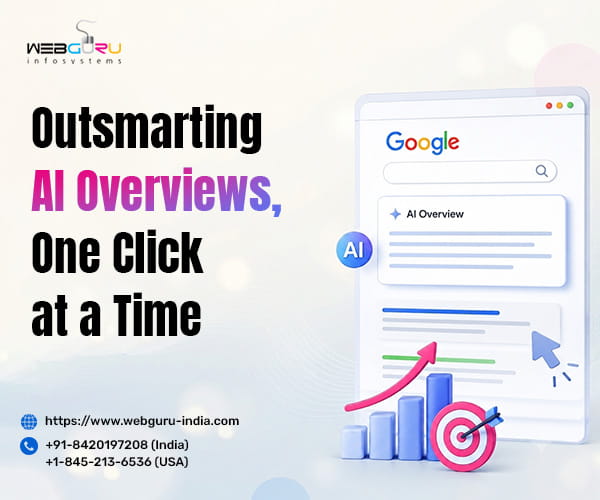
Search isn’t working the way it used to. AI Overviews now sit at the top of countless search results, delivering answers directly to users and quietly pulling traffic away from the websites that would have earned those clicks a year ago. It’s a shift that’s catching a lot of businesses off guard, especially those whose entire growth strategy has leaned on ranking well and letting organic traffic do the rest. This post breaks down what’s driving the change, why it’s moving faster than expected, and what businesses can actually do to stay visible, relevant, and click-worthy in a search landscape increasingly shaped by AI.
Ranking #1 on Google used to mean one thing: traffic. Not anymore.
Type a question into Google today, and there’s a good chance you get your answer before you ever see a blue link — courtesy of an AI Overview sitting right at the top of the page. No click. No visit. No conversion. Just a neatly summarized answer, and your carefully optimized page buried underneath it.
This is the new reality of search, and it’s exactly why smart digital marketing services now need to do more than chase rankings. They need to chase visibility inside the answer itself, and clicks from the people who still want more than a summary.
Unlike what many may think, AI Overviews aren’t an SEO death sentence. They’re a filter. The casual, “just curious” searchers get their answer and move on. The people who click through now are further along, more specific, and more ready to buy. Fewer visitors, but better ones.
Below are five practical ways to adapt your strategy — and actually come out ahead.
Strategy 1: Pivot to High-Intent, Long-Tail Commercial Keywords
AI Overviews are exceptionally good at answering broad, definitional questions. Ask “what is responsive web design?” and Google will hand over a tidy summary without you lifting a finger and without sending a single visitor your way.
Where AI Overviews struggle is specificity. They can’t easily replace a page built around a real business decision, a niche use case, or a service someone is actively trying to buy.
The fix: Stop competing for the broad, informational searches AI already owns. Go after the queries that signal someone is ready to act.
- Map your content calendar to commercial and transactional intent, not just informational curiosity.
- Target long-tail, multi-word phrases — think “custom web application development for enterprise logistics” instead of “what is web development.”
- Use zero-click keyword filters in your research tools to spot terms where organic click-through rates are still strong. Prioritize those over high-volume, low-value queries.
There will be fewer searches, true. But the ones left are searches with a buyer behind them.
Discover how to build a content strategy that actually drives leads.
Strategy 2: Optimize for AI Inclusion & Answer-First Formatting
If Google is going to put an AI Overview above your listing anyway, your next best move is making sure your site is one of the sources it actually cites.
This matters more than ever. Research from Gartner projects that traditional search engine volume will drop 25% by 2026 as users increasingly turn to conversational AI and search engines lean harder on generative answer blocks. This is not a distant trend; it’s a countdown. Answer Engine Optimization (AEO) isn’t optional anymore. It’s the next layer of technical SEO.
The fix: Structure your content so both search engines and large language models can lift, parse, and cite it easily. Under every H2 or H3, answer the question in 30–50 words before you expand on it. AI systems favour content that gets to the point fast, as do most visitors.
- Add FAQPage and HowTo schema markup so your structured data speaks the language machines expect.
- Keep headings literal and question-based, matching how people actually search.
- Get your E-E-A-T signals (Experience, Expertise, Authoritativeness, Trustworthiness) in order — author bios, credentials, original sourcing. An experienced SEO Company in India can handle the technical schema work and E-E-A-T architecture that most in-house teams don’t have bandwidth for. Getting it wrong here means getting left out of the citations entirely.
Strategy 3: Build Digital Products & Interactive On-Page Tools
AI Overviews cannot run your ROI calculator, log a user into a portal, or let someone configure a quote in real time. Static information gets summarized. Interactive experiences don’t. That is still in your control.
The fix: Give people a reason to click through that has nothing to do with reading more text.
- Build custom calculators. Project cost estimators, ROI tools, savings comparisons, or anything that requires individuals to visit your site to get value.
- Invest in native mobile apps and web platforms that turn a one-time visitor into a logged-in, returning user.
- Pair your web development with mobile app development so the experience doesn’t end when the browser tab closes and follows the user onto their phone.
An AI summary can tell someone what a service does. It can’t do it for them. This gap is your opportunity.
Strategy 4: Focus on High “Information Gain” & Proprietary Data
Most content on the web says the same thing in slightly different words. This is precisely the kind of content AI Overviews are built to absorb, summarize, and serve up, but without ever crediting or clicking through to the source.
The fix: Stop writing the content everyone already has. Write the content only you have.
- Publish real client case studies with actual performance numbers, not vague success stories.
- Run your own proprietary surveys or technical experiments and publish the raw findings.
- Add genuine point-of-view commentary and lived experience. This is the kind of specific, opinionated insight a scraper can’t synthesize from ten other blog posts.
If your content can be replaced by a summary of five competitors’ articles, it will be. If it can’t, it becomes a citation instead of a casualty.
Strategy 5: Diversify Traffic Channels Beyond Google Search
Every business that leans entirely on organic Google traffic is one algorithm update away from a bad quarter. AI Overviews just made that risk a lot more visible.
The fix: Build owned channels that don’t depend on where Google decides to place your listing.
- Turn website visitors into newsletter subscribers with a genuinely useful lead magnet — not a generic “sign up for updates” form.
- Run targeted PPC and social media marketing campaigns to keep top-of-funnel traffic flowing regardless of what the SERP looks like this month.
- Invest in video content on YouTube. Video carousels frequently sit alongside or above AI Overviews, giving you a second shot at visibility on the same page.
Diversification isn’t a backup plan anymore. It’s the plan.
Understand SEO, AEO & GEO. Discover what to do for search everywhere in 2026.
Adapting Your Digital Strategy for the AI Search Era
Zero-click search isn’t going away, and pretending otherwise won’t protect your traffic. But the brands that rethink their content architecture, tighten their technical SEO, and build genuinely useful on-site experiences aren’t just surviving this shift. They’re capturing higher-quality leads because of it.
That’s the real opportunity here: fewer, better visitors who are ready to act. Getting there takes a strategy built for how people search today, not five years ago — which is exactly what the right Digital Marketing Services partner should be helping you build.
If you’re ready to turn AI Overviews from a threat into an advantage, Webguru Infosystems can help you architect the web development, applications, and growth-focused digital marketing that gets you there. Talk with our professionals, and plan on how to hold that position zero on page 1.

Srishti Bhattacharyya
A writer driven by a love for words, who is constantly exploring new ways to push the boundaries of expression. Always testing the limits of creativity, she finds inspiration in books, painting, and the endless ideas waiting on Pinterest.
-
1000+
Happy
Clients -
25+
Countries
Served -
20+
Years of
Trust
I need help with...